Tuesday, August 11, 2009

Sensing your Clitoris

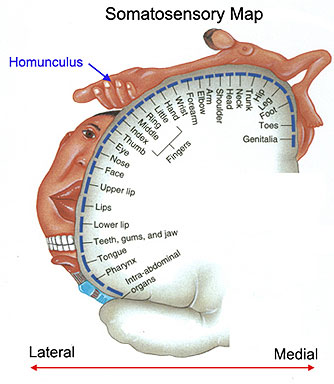
Let's talk about sensing. You have touch receptors over all your skin. The number of touch receptors in the skin depends on the body part. For example, your fingertips have more of those receptors than your arm. The motor cortex in your brain processes this sensory information from all your body parts. Unsurprisingly, those body parts with more touch receptors are processed in a larger area of the motor cortex.

This can be represented in a sort of body map, called homunculus, in which the size of the body parts is proportional to it's representation in the cortex, and is placed onto the region of the cortex that represents it.


However, although a bunch of body parts have been localized in this "body map" in our cortex, it was still unknown where the clitoral stimuli is processed. Swiss scientists worked to fill that gap of knowledge and studied 15 healthy women to map the somatosensory representation of the clitoris (Michels et al., 2009). The Neurocritic gave a great discussion of this paper. Go visit and take a look at the brain image and where the clitoral stimulus is processed.
Curious about their methods?
Prior to the imaging session, two self-attaching surface disc electrodes (1 × 1 cm) were placed bilaterally next to the clitoris of the subjects so that we were able to stimulate the fibers of the dorsal clitoral nerve. Before the start of the experiment, electrical test stimulation was performed to ensure that subjects could feel the stimulation directly at the clitoris. In addition, the strength of electrical stimulation was adjusted to a subject-specific level, i.e. that stimulation was neither felt [as] painful nor elicited – in case of clitoris stimulation – any sexual arousal.


(It makes me want to make a pin-the-tail type game with a fMRI image of the brain and some body part cartoons.)


Friday, July 24, 2009

THE DRAMA KINGS ARE OUT!

OMFG you guys, 2 of the colleagues with serious issues are out! One graduated, and my PI ran out of money to pay for the research associate. Also the crazy visiting professor is MIA. I can work! Uninterrupted by stupid comments! I can drink coffee without people making an issue of it!

A couple of weeks ago I finally solved the project boundaries issue with the senior research associate. I told the PI to please make a list of the projects within the grant project and specify to whom each task belongs to. I also asked to pump up the projects of the sen. res. assoc. and make mine look simple and uninteresting to avoid having him feel cheated/taken advantage of.
The PI gave us both the list and the sen. res. assoc. approved - and actually quite liked- having things set down on paper like that. So my professional relationship with him is good now, and we are collaborating nicely.

LAB PEACE YAY!

Monday, July 13, 2009

Update: Lab Wars

I have a new Twitter account, and due to that and the unfolding lab drama I haven't been posting here as often as I would like. Lab-wise, up to now, I have been able to avoid getting into the petty lab war currently going on.
After the first, open phase of Lab War, I made the point to stay far away from Lab War conversations by anyone involved. My theory that the war started by a failure to communicate properly about a collaborative project still stood, so I don't necessarily think anyone is on the right.
Despite the warnings not to go to the next groupmeeting, given by RA2, I went. I expected him to bash the guys involved, certainly, but I didn't expect him to appropriate basically all the projects in the lab - including my thesis project.
This was a low blow. Up to this point I hadn't had any problem with RA2. Au contraire, he has always been very kind and respectful towards all the women in the lab. So I went out to have a really good lunch, some awesome blueberry vodka with champagne, and some venting time away from all the other people pissed off about the meeting.
Mid twitter venting- by this time I was having a sangria in some other place- my boss emails me to go talk to him. Damn. I calm down as best I can and head back to the lab.
The boss agreed that what RA2 had done over groupmeeting was wrong and over the top, and promised to talk to the guy about it.
Then on Saturday, when I came over to do some benchwork, RA2 showed up to talk to me. He apologized if he had 'hurt my feelings' (my feelings? WTF? That has nothing to do with anything!). I listened for about an hour, trying to make him understand that I just needed to have my part of the project to myself without him going paranoid over people 'stealing his projects' and/or taking advantage of him.
I told him that the umbrella project that has my thesis project, as well as a lot of other projects was not clearly divided by our PI. I told him I wasn't upset at him, just upset there weren't some clear boundaries between the different projects to allow us to work without stepping in each other's toes, and that it was our PI's responsibility to place those boundaries.
The conversation with him made me realize that, regardless of how things have actually happened, RA2 feels that a lot of the projects of the lab work thanks to him and people don't give him enough credit. He also thinks that basically all the projects with my protein - with the exception of the electrophysiology studies- are his. And no matter how you broach the matter, as I later learned from another of the female grads that had also talked to him that day, he would not change his mind.
This meant that somehow I had to get my professor to set boundaries in the project without upsetting RA2. Regardless of people's personalities I have to collaborate with lab members on both sides of the Lab War, and I rather work on good terms with people.
Thursday, July 2, 2009

Britni's moved!

Brit's got a spanking new address, so update your bookmarks!

Sunday, June 28, 2009

Another smart woman murdered

A student of one of my much-loved chemistry professors was murdered back home. She was chilling out in la calle San Sebastian at Old San Juan when a 15- year old kid from La Perla (a nearby black market slum) opened fire trying to get some dude that was hiding behind her.

La calle San Sebastian is part of the tourist areas, and everybody hangs out over there. I have cousins that live in that street. Usually the bichotes know better than to mess with the tourist areas because that means the cops will be all over their asses. But apparently the bichotes are now recruiting minors as shooters because they get served lighter sentences.
Puerto Rico, like Miami and NYC, is one of the biggest drug ports in the US. However, the resources it has to deal with the drug market are minimal. And every year the violence related to drug traffic gets worse.


Tuesday, June 23, 2009

Science research extravaganza

I finally had enough time to go through my research rss feed. Here are the links to the posts I find the most interesting and/or important for everyday living. Enjoy!

  • Jonah Lehrer (remember cute guy pic from a recent CEFAD post - him) explains the Endowment Effect - or why I paid a ridiculous amount for a gorgeous ring I bought impulsively after my A exam.
  • The first group of Bonobos is being relocated from the Lola Ya Bonobo sanctuary and into the wild!
  • Dave explains a model of how we perceive maps, directions, and finally - video games.
  • Isis's husband receives a very serious warning over eating the last ice cream sandwich - that's cold, man.
  • Your stomach is a lying bastard. Dave explains a curious study that measured satiety when the control group was served by waiters and the others had a self-refilling bowl.
  • Neuroskeptic has a very thorough post about the marketing of some antipsychotics when they are new, and just about as effective as previous treatments.

Hidden beliefs in science stereotypes predict size of gender gap across 34 countries

Please go read Ed's excellent piece on how biases and the gender gap in the sciences feed off each other.
Among the findings:
So the more a nation believes in the stereotype of the scientific male (even unconsciously), the greater the gap in performance between boys and girls in both science and maths. In fact, these hidden biases were a better predictor of the gender divide than what people actually said about science stereotypes. These explicit opinions accounted for about 2% of the international variation in the science sex gap, while implicit associations accounted for a much larger 19%.